
Meghnad Saha — The Saha Ionization Equation
The equation that lets us “read” the temperature of stars
How do scientists know how hot a star is, when nobody can travel there to check with a thermometer? The answer starts with an equation written by an Indian physicist named Meghnad Saha in 1920.
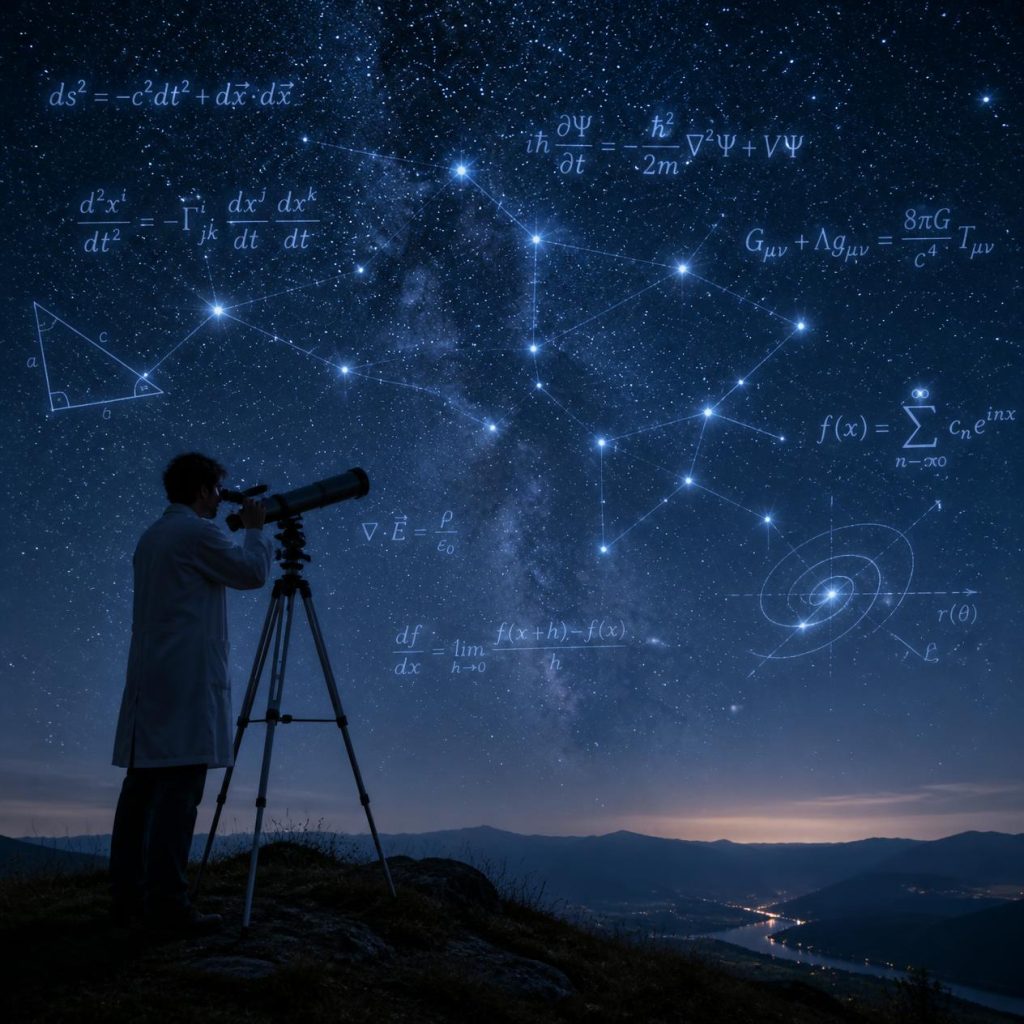
When astronomers look at starlight through a special instrument, they see a pattern of lines called a spectrum — a kind of fingerprint of the light. Before Saha, scientists could see that different stars had different patterns, but they didn’t have a reliable way to connect these patterns to a star’s actual temperature.
Saha’s equation solved this. It connects the temperature and pressure of a gas to how “ionized” its atoms are — in simple terms, how many electrons have been knocked loose from the atoms by heat. Since a star’s spectrum reveals exactly how ionized its gases are, Saha’s equation lets scientists work backward and calculate the star’s temperature precisely. This one equation became the foundation for classifying every star in the sky, a system still used by astronomers today.
Saha didn’t stop at the stars, though. Later in his life, he applied his scientific thinking to very earthly problems in India — helping plan river and flood control projects, and pushing for a more scientifically accurate calendar. He believed that a scientific discovery wasn’t truly finished until it had been put to use helping real people.
Why this matters today: Saha’s story carries an old Indian idea in modern form — “as it is in the small, so it is in the vast” (yat pinde tat brahmande). A law discovered in a small laboratory on Earth turned out to describe every star in the universe. And his own life reminds us that knowledge is not complete when a paper is published — it is complete when it has been used to make someone’s life better.