
Atomic Leadership 2047: Channeling Shunya & Kanaad for India’s Next Leap
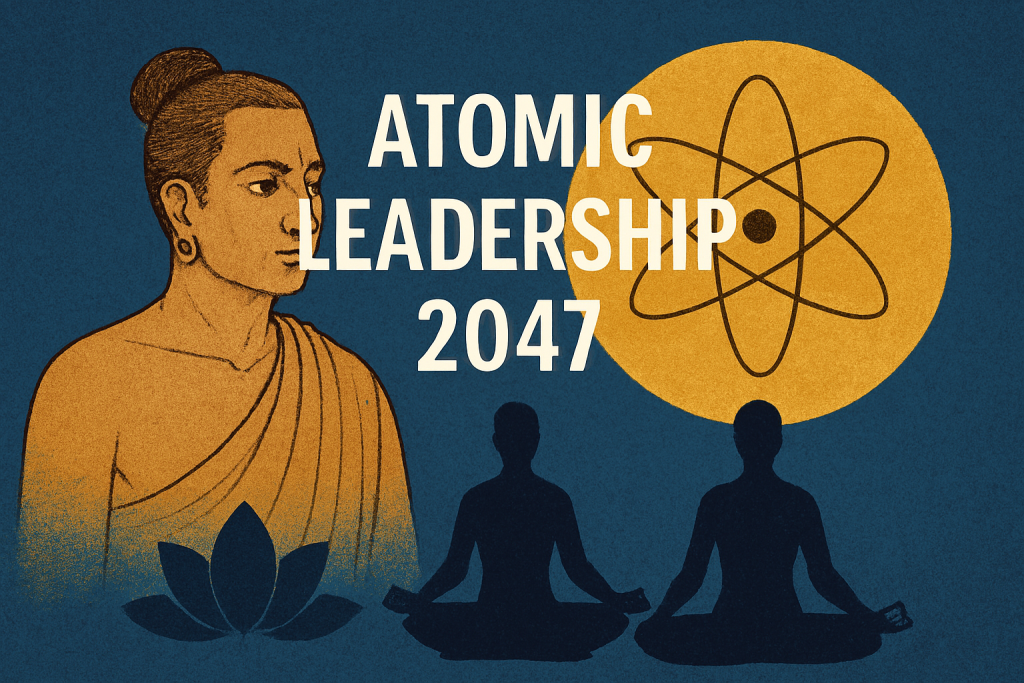
India’s next century demands leaders who are both surgically precise and deeply humane — leaders who act like atoms: minimal in footprint, maximal in catalytic effect. Atomic Leadership fuses Kanaad’s logic-driven clarity with Shunya’s generative emptiness, producing interventions that are measurable, reversible, and infused with dharmic purpose.
Kanaad’s Logic as Leadership Practice
Kanaad framed an ontology of indivisible units and rigorous inference that became the basis for Vaisheshika thought and hypothesis-driven inquiry. Leadership that thinks like Kanaad formulates crisp hypotheses, reduces initiatives to essential tests, and insists on observable markers for success and failure. Use Kanaad’s minimalism to design interventions that reveal whether your core assumption is true with the least possible disturbance.
Shunya Transmission Emptiness as Field of Potential
Shunya or śūnyatā is a philosophical practice of emptiness that is not nihilistic but generative — a condition in which possibilities arise when fixed identities and egoic attachment fall away. Leadership through Shunya creates receptive spaces for stakeholder emergence, centers deep listening before action, and treats silence as an instrument of insight. Combine Shunya’s open field with Kanaad’s diagnosis and you get decisions that are compassionate in motive and sharp in execution.
Alignment with Vision India 2047 Concrete Pathways
Vision India@2047 envisions transparent, citizen-centric, and transformational governance built on digitalization, evidence, and participatory institutions. Atomic Leadership operationalizes that vision by:
- Designing transparency-by-design systems with simple, auditable decision logs and public feedback loops.
- Seeding small, time-boxed pilots with clear success metrics so learning scales without political risk.
- Making citizen-centricity procedural through listening labs, living experiments, and iterative policy replication packs that states can reuse.
These tactics keep Vision 2047 ambitious yet experimentally tractable.
Practical Tips for Emerging Indian Leaders
- Cultivate presence, then precision: start meetings with two minutes of shared silence and follow with a one-page hypothesis and three metrics.
- Make experiments reversible: add sunset clauses, rollback plans, and pre-agreed evaluation windows.
- Publish auditable decision artifacts: data schemas, rationale notes, dissent log and impact metrics in plain language.
- Run public listening rituals, then small expert design sprints for executable plans; publish both rationale and contested views.
- Seed Shunya spaces: cross-disciplinary residencies, citizen labs, and slow-policy hours where no immediate deliverable is demanded.
- Ask Kanaad’s minimal test: “What minimal change would prove or disprove our theory?” and run that micro-experiment first.
- Require short ethical impact statements for every initiative covering equity, dignity, privacy, and climate.
- Translate technical plans into local idioms by pairing technologists with community stewards.
- Publish modular replication packs with playbooks, pitfalls, and data templates so local pilots can be recombined.
- Institutionalize learning: quarterly “what-we-learned” memos that are public and actionable.
Closing and Call to Action
Atomic Leadership 2047 asks Indian leaders to steward possibility with discipline: listen like Shunya, test like Kanaad, and deliver for citizens like Vision 2047 demands. Get in touch with us at info@shunyaxis.com to explore workshops, frameworks, or a short pilot to introduce Atomic Leadership in your organization.
References
- Vision India 2047 final report Government of India Department of Administrative Reforms and Public Grievances official document.
- NITI Aayog Vision and strategy documents on long-term national transformation and governance reform.
- Government of India Digital India program resources on transparency, open data, and citizen services.
- Ministry of Electronics and Information Technology guidelines on open data and auditable digital systems.
- Ministry of Personnel Public Grievances and Pensions reports on participatory governance and citizen feedback mechanisms.
- Department of School Education and Literacy NEP 2020 guidance on educational transformations and experiential learning.
- Ministry of Corporate Affairs corporate governance frameworks and ethical compliance guidelines relevant to institutional leadership.
- UN SDGs India Index guidance on measurable indicators and state-level pilot initiatives aligned with sustainable development goals.
- Shunyaxis Home page — ShunyaAxis philosophy and initiatives https://shunyaxis.com
- Rajesh Timane Blog timane.rajesh.wordpress.com articles on Shunya and educational practice https://timane.rajesh.wordpress.com